
Universal Transmission Bench Emulator – Bringing Real-World Transmission Testing to the Bench
Universal Transmission Bench Emulator – Bringing Controlled Transmission Testing Beyond the Original TCU
Modern mining and industrial transmissions are highly sophisticated systems. While Transmission Control Units (TCUs) make machines easier and safer to operate, they can also create a challenge during diagnostics and development.
When a transmission fault occurs, technicians are often forced to troubleshoot complete machines under pressure, with expensive downtime, limited visibility and restricted control over transmission behavior.
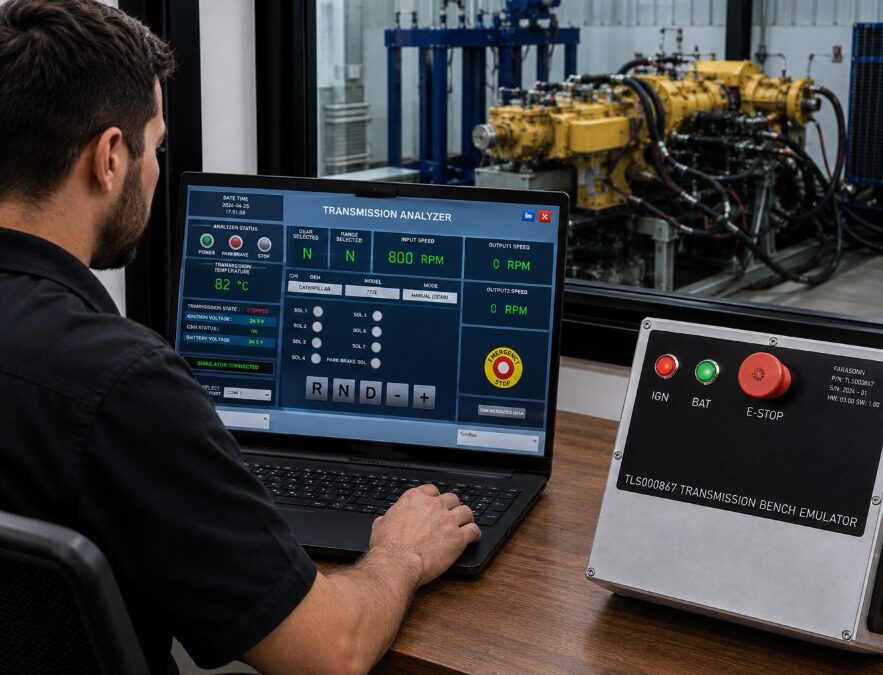
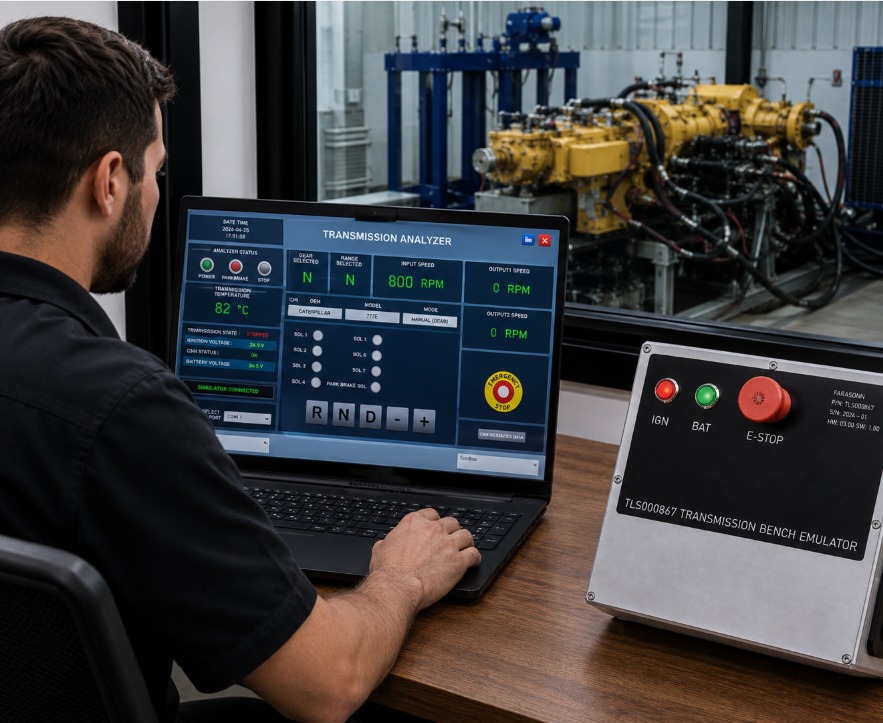
At Farasonn, this challenge led to the development of the Universal Transmission Bench Emulator (UTBE) — a software-driven platform designed to operate and test transmission systems under controlled conditions while temporarily replacing the original TCU during bench testing.
The objective was simple:
Create a better way to understand and test the transmission itself.
Why We Developed It
Like many engineering projects, the Universal Transmission Bench Emulator started from practical field experience.
Initially, transmission systems appear very different:
- Different OEMs
- Different harnesses
- Different shift strategies
- Different machine applications
- Different control philosophies
The conventional approach would be to create dedicated test equipment for every machine platform.
However, after years of working with mining and industrial equipment, a pattern emerged:
Most transmission systems share common building blocks.
The differences often lie in:
- Shift logic
- Solenoid combinations
- Clutch activation strategies
- Safety interlocks
- Gear sequencing
- Signal mapping
- OEM-specific operating rules
Instead of creating a unique tester for every application, we started combining these common elements into a universal software-controlled architecture.
Universal Hardware. Software-Defined Profiles.
The Universal Transmission Bench Emulator follows the same engineering philosophy used in our Universal Engine Emulator platform:
Build robust hardware once.
Adapt behavior through software.
Rather than redesigning electronics for every transmission platform, configurable profiles allow the system to adapt to different applications.
As new machines are encountered, profiles can be refined and expanded.
Examples include:
- Mining haul trucks
- Motor graders
- Dozers
- Articulated dump trucks
- Industrial equipment
- Future OEM applications
This creates a scalable platform while maintaining a consistent hardware foundation.
Beyond the Original TCU
Traditional TCUs are designed to operate machines under normal service conditions.
Their primary purpose is machine operation — not detailed transmission diagnostics.
Most OEM systems therefore follow fixed operating logic:
- Predetermined shift schedules
- Automatic gear decisions
- Fixed clutch strategies
- Predefined protection logic
- Restricted operator access
While this works well during normal machine operation, it introduces limitations during testing.
Technicians may need answers to questions such as:
- “Can we activate only the third clutch?”
- “Can we hold the transmission permanently in a specific gear?”
- “Can we isolate a specific solenoid combination?”
- “Can we observe the mechanical response independently?”
In many cases, the original TCU simply does not allow these actions.
Temporarily Replacing the TCU
The Universal Transmission Bench Emulator temporarily replaces the machine’s original TCU during controlled testing.
This allows engineers and technicians to directly control transmission behavior through software.
Rather than following OEM shift schedules, the UTBE allows controlled inputs and customized transmission operation.
Depending on the transmission profile, engineers can:
- Directly activate clutch combinations
- Control individual solenoid outputs
- Hold specific gears
- Test forward and reverse operation
- Simulate transmission conditions
- Observe transmission reactions
- Evaluate mechanical and hydraulic operation
- Validate transmission behavior under controlled conditions
The purpose is not simply to operate the transmission.
The purpose is to understand what the transmission is physically doing.
Focused on Mechanical and Hydraulic Testing
One of the key goals of the UTBE is enabling engineers to evaluate the transmission itself — independent of higher-level machine logic.
By removing predefined shift behavior, testing can focus on:
- Mechanical clutch response
- Hydraulic operation
- Solenoid functionality
- Gear engagement behavior
- Shift reactions
- Fault isolation
This creates a controlled environment where engineers can isolate faults and better understand transmission behavior before returning equipment to service.
Built from Real-World Field Requirements
The Universal Transmission Bench Emulator was not developed as a laboratory exercise.
It evolved directly from field requirements:
- Machines waiting for diagnostics
- High downtime costs
- Limited troubleshooting visibility
- Repeat failures
- Complex transmission interactions
- Pressure to reduce machine downtime
Every new machine profile and every challenge adds another layer of capability.
The platform continues evolving alongside the industries it supports.
Designed to Grow
The UTBE platform still has room for expansion.
Future developments may include:
- Expanded transmission profile libraries
- Additional communication protocol support
- Automated validation routines
- Advanced diagnostics
- Data logging and analysis tools
- Broader OEM compatibility
The long-term goal extends beyond transmission testing.
The goal is creating an adaptable engineering platform capable of evolving together with modern machine technology.
Practical Engineering First
At Farasonn, we believe practical engineering creates the greatest value.
The Universal Transmission Bench Emulator was developed with a straightforward objective:
Reduce troubleshooting complexity, improve visibility and create a safer, more controlled method for understanding transmission behavior.
Because sometimes the fastest way to solve a transmission problem is not by replacing components.
Sometimes it starts with asking:
“What is the transmission actually doing?”
Then creating a way to find out.