

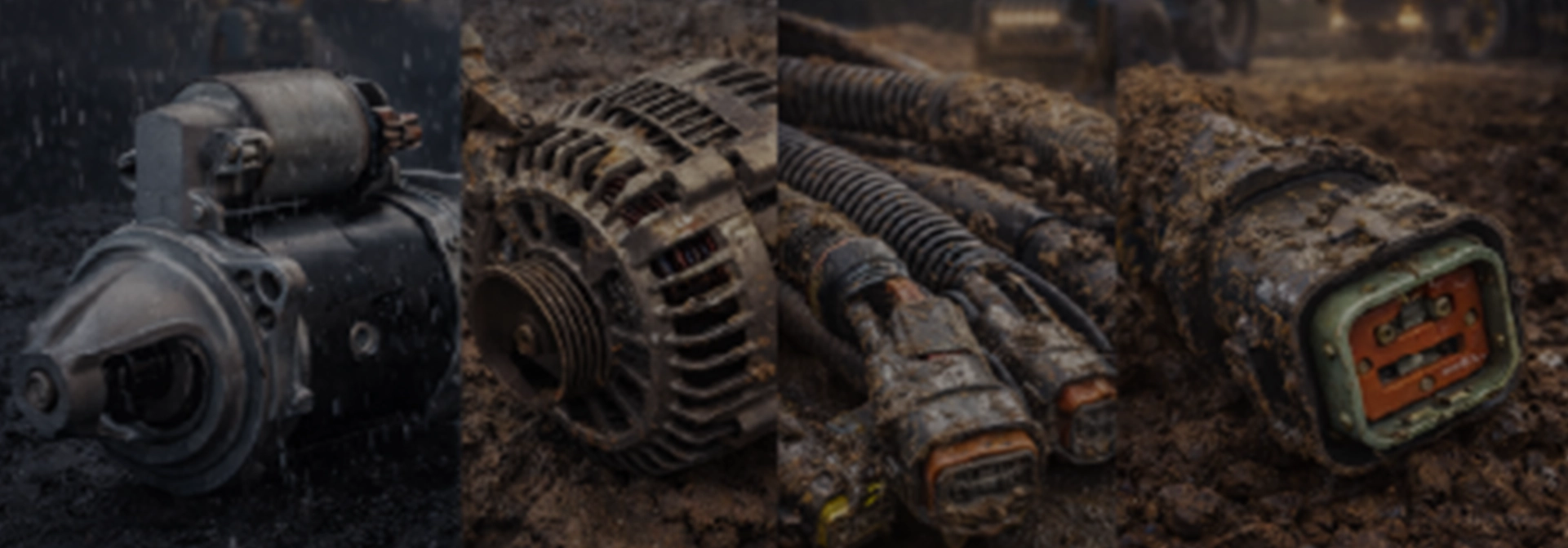
Choosing the Right Heavy-Duty Electrical Equipment for Harsh Sites
Mining, agriculture, and off-highway industries place significant stress on vehicle electrical systems.
Machines operate in environments where vibration, dust, moisture, and temperature fluctuations continuously challenge the reliability of electrical components.
Selecting appropriate heavy-duty electrical equipment is therefore not only a specification decision but a reliability decision. Incorrectly specified components often result in repeated electrical faults, difficult troubleshooting, and unnecessary downtime.
Engineers, fleet managers, and procurement teams must therefore consider not only component ratings, but also how those components behave when exposed to vibration, contamination, and long operating cycles in real field conditions.
The Reality of Harsh Operating Environments
Unlike passenger vehicles operating on sealed roads, equipment used in mining and agricultural environments operates under constant mechanical and environmental stress.
Electrical components must routinely tolerate:
- Continuous high-frequency vibration
- Dust and fine particulate contamination
- Water ingress during rain or washdowns
- Mud, oils, and chemical exposure
- Mechanical impacts from rough terrain
- Sustained high electrical loads
In these environments, electrical failures are rarely caused by catastrophic component failure. Instead, they typically develop gradually through mechanical fatigue, corrosion, or insulation damage.
For example, a wiring harness routed across a chassis bracket without adequate abrasion protection may initially operate normally. Over time, vibration gradually wears through the insulation until the conductor contacts the chassis, resulting in intermittent faults that are difficult to trace.
Similarly, connectors exposed to moisture or dust can slowly develop corrosion on contact surfaces. As resistance increases, voltage drop under load begins to affect system performance.
Designing electrical systems for harsh sites therefore requires careful consideration of both component selection and installation practices.
Key Components That Require Careful Selection
Several electrical components have a disproportionate influence on the reliability of heavy-equipment electrical systems.
Starters
Heavy-duty starters must consistently produce sufficient torque to crank large engines under demanding conditions.
Important engineering considerations include:
- Torque capacity relative to engine compression
- Heat tolerance during repeated start cycles
- Mechanical durability under engine vibration
- Secure mounting alignment with the ring gear
- Service accessibility in field conditions
In heavy equipment applications, starter failures are often caused by mechanical factors rather than internal electrical faults. Misalignment, loose mounting bolts, or vibration-induced bracket movement can cause improper engagement with the flywheel, leading to premature wear of both the starter drive and ring gear.
Alternators
Alternators supply the electrical power required for lighting systems, control electronics, sensors, HVAC systems, and auxiliary equipment.
Correct specification should consider:
- Continuous output relative to total electrical load
- Performance at low engine speeds
- Cooling effectiveness in high ambient temperatures
- Voltage stability during fluctuating loads
- Structural integrity of mounting brackets
A common field issue occurs when electrical demand exceeds alternator capacity. In these cases the battery repeatedly compensates for the deficit, leading to chronic under-charging and premature battery failure.
Additionally, alternators mounted on poorly supported brackets are exposed to continuous vibration, which can lead to internal regulator failure or cracked housings over time.
Wiring Harnesses
Wiring harnesses form the physical backbone of the vehicle electrical system and are frequently the source of electrical faults in harsh environments.
Effective harness design requires attention to:
- Correct conductor sizing for load requirements
- Insulation materials suitable for temperature exposure
- Abrasion protection such as braiding or conduit
- Secure routing away from sharp edges and moving parts
- Proper strain relief near connectors and branch points
- Regular harness support using clamps or mounting points
Long unsupported harness runs are particularly problematic. Constant vibration concentrates mechanical stress at connector terminations, eventually leading to conductor fatigue inside the insulation.
Harness protection is equally important. In mining and agricultural machinery, harnesses are often exposed to abrasive dust, hydraulic components, and sharp structural edges. Without appropriate protective braiding or conduit, insulation damage becomes inevitable over time.
Connectors
Electrical connectors are common failure points because they combine electrical contact surfaces with mechanical and environmental exposure.
Connectors used in harsh environments should provide:
- Reliable electrical contact under vibration
- Effective sealing against dust and moisture
- Corrosion-resistant terminals
- Positive locking mechanisms
- Terminal retention systems to prevent pin movement
Connectors suitable for harsh environments typically incorporate secondary locking features that prevent terminals from backing out under vibration.
Without adequate sealing and retention systems, connectors may appear mechanically secure while still producing intermittent electrical faults due to partial contact loss or contamination.
Importance of Electrical System Integration
Electrical reliability is rarely determined by the quality of a single component. In practice, most failures occur when multiple small weaknesses combine within a system.
Common contributing factors include:
- High-resistance grounding points
- Insufficient harness protection
- Connector contamination or corrosion
- Voltage instability within the charging system
Grounding quality is frequently underestimated. Poor grounding surfaces, painted mounting points, or loose earth connections introduce electrical resistance that can produce erratic system behaviour.
In heavy equipment electrical systems, properly prepared grounding points with clean metal contact and corrosion protection are essential for stable system operation.
Reducing Downtime Through Correct Specification
Downtime in mining and agricultural operations can have significant operational and financial consequences.
Many electrical failures encountered in the field are preventable through better system specification and installation practices.
Reliability improvements often come from relatively simple engineering considerations such as:
- Proper harness routing and support
- Effective abrasion protection
- Secure strain relief at connectors
- Correct ingress protection levels for connectors
- Stable charging system capacity
Addressing these factors during system design and component selection significantly reduces troubleshooting time and improves long-term equipment reliability.
Conclusion
Electrical systems operating in harsh environments must be designed with durability, vibration resistance, and environmental protection in mind.
Careful specification of starters, alternators, wiring harnesses, and connectors is essential to ensure reliable operation in mining, agricultural, and off-highway equipment.
Equally important are system-level considerations such as harness routing, strain relief, connector sealing, and grounding quality.
When these engineering principles are applied consistently, electrical systems are far more likely to withstand the demanding conditions typical of heavy equipment operations.